41% of tasks on the to-do list are never completed.
Why does this happen?
Poor prioritization is often to blame. You choose easier tasks over important and challenging ones. Over time, the unattended tasks pile up and become overwhelming, causing you to start avoiding your list altogether.
Sound familiar?
Procrastination and a to-do list as long as a Walmart receipt are other culprits. They can quickly transform your list from a productivity tool into a source of stress, anxiety, and disappointment.
Below, I break down why your to-do list never gets finished. I also share simple, actionable steps to help you get through it.
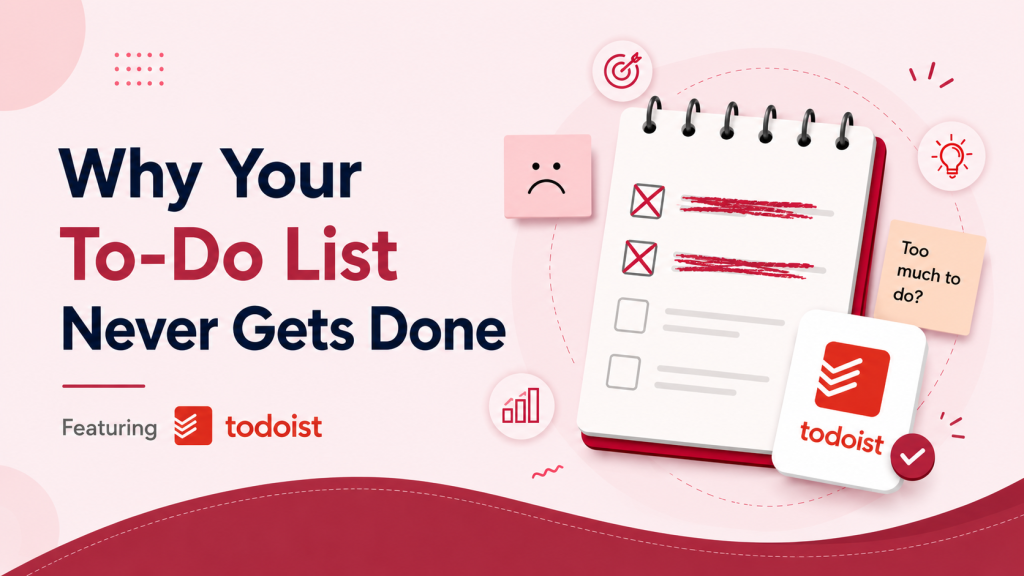
Why Your To-Do List Never Gets Done
We’ve all been there: making a to-do list we don’t finish. Then dealing with the frustration, self-doubt, and sinking feeling that you didn’t do enough.
Most of the time, it’s not entirely your fault. Failing to get your list done is usually a result of:
1. Unrealistic planning
You wake up at 2am with this burning desire to fix your entire life. Fired up, you create a to-do list that looks just like this:
- Deep work for 5 hours
- Apply to 15 jobs
- Exercise for 2 hours daily
- Read 8 chapters of a book daily.
- Network with 5 professionals daily
On paper, the list looks like the perfect recipe to turn your life around. But in reality? It’s far-fetched.
Take it from someone who has been there. During my cold-pitching days, I created a to-do list to pitch 4 businesses daily.
But guess what?
I got stuck on sending one pitch. Eventually, I stopped altogether because the goal was unrealistic and unsustainable.
Here is what happened: I didn’t factor in those little distractions, fatigue, interruptions, and what it’ll take to achieve the goal (finding leads, researching each business, crafting a personalized email, etc.)
It’s possible you relate to that story. If yes, the best way to overcome unrealistic planning is by planning for a normal day—where your focus and energy fluctuate, and your dog distracts you—not a perfect one—where everything works in your favor.
2. Energy mismatch
Research shows that most people’s energy peaks in the late morning, drops in the early afternoon, and rebounds a bit in the evening.
I can relate. But it could be different for you.
It’s possible your energy peaks in the early afternoon and drops in the late afternoon. Or peaks in the early evening and declines in the late evening.
Regardless, planning your tasks—especially high-focus ones—around your peak energy hours helps you get more done with less effort.
It also makes tackling complex tasks easier. For example, I usually avoid writing research-intensive articles during late evening (9-11pm) because my focus, critical, and analytical thinking aren’t the sharpest at that time.
3. Constant interruptions and shifting priorities
15 minutes into deep work, your phone chimes. It’s an email notification from your boss. You take a quick glance at its content. It’s nothing urgent, so you return to work.
10 minutes later, your phone buzzes with a WhatsApp message. It’s a 3-minute voice note from your little sister who just returned from college. You listen for a minute to understand the context. Then return to work.
Every few minutes, something steals your attention, forcing you to context switch. The result? Loss of focus, depleted energy, and impeded cognitive function. In the end, your daily plans get disrupted, and you struggle to finish your to-do list.
4. Vague and poorly defined tasks
“Write the service page of my portfolio website” is one project that has been sitting on my to-do list for a while. Yet, I struggled to get it done—day after day, week after week.
Turns out, it was vague.
Seeing “Write the service page of my portfolio website” on my to-do list felt overwhelming, especially as it was undefined with no clear starting point. So I kept postponing it for days.
One random day, I started and completed the project within 48 hours.
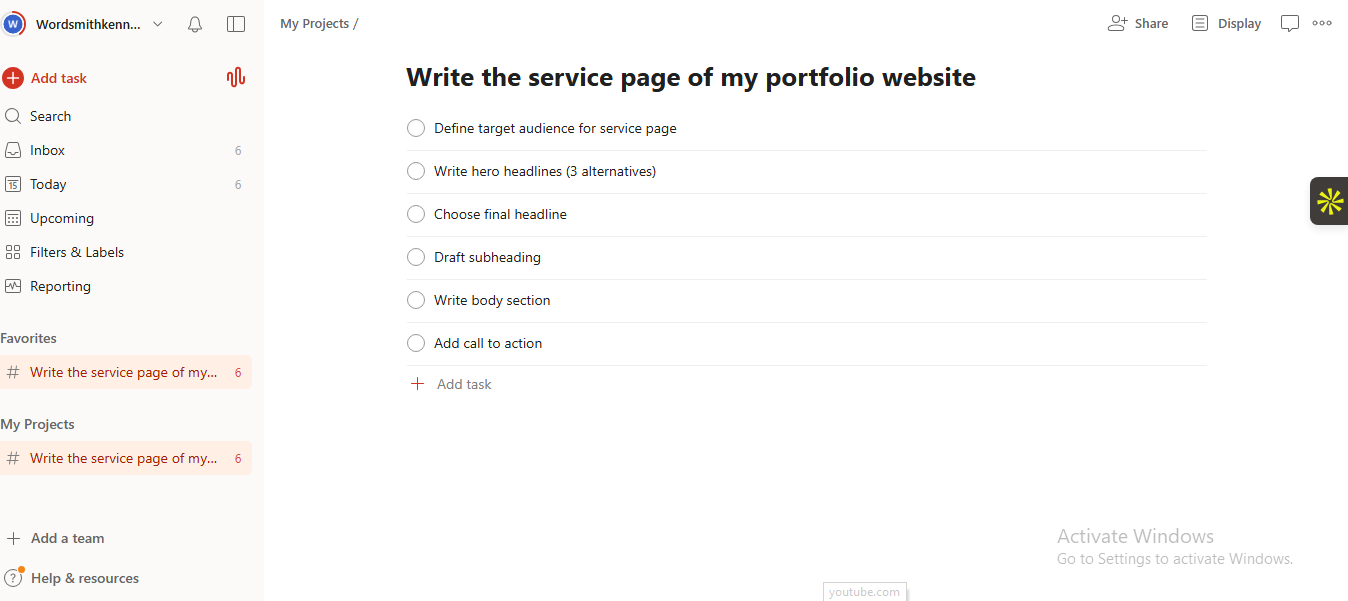
Here’s what I did: I translated the project into clear, actionable steps. So instead of “Write the service page of my portfolio website,” I broke it down into this:
- Define the target audience for the service page.
- Write hero headlines (3 alternatives)
- Choose the final headline
- Draft subheading
- Write body section
- Add call to actions
Doing so made the project more defined, so I knew what to do and where to start. That clarity reduced friction.
A more effective approach would be to use Todist. It allows you to organize projects by breaking them into smaller tasks. Then you can add descriptions, reminders, and due dates to create urgency.
Here is how it actually looks:
5. Fake productivity loop
Imagine you have a to-do list that says:
- Reply to two emails
- Organize desk
- Update Chrome browser
- Write sales copy
- Cold pitch 3 SaaS brands
Chances are you’d spend most of your time tackling the first three projects. Why? They are easy and straightforward compared to others. And completing them gives you a sense of progress, making your day feel productive.
But here is the thing: it’s a trap!
Spending a lot of time on easy tasks means hard and important tasks get postponed. Yes, you feel busy. But the truth is, you’re not productive.
Luciana Paulise, Career Coach and Author of Timebox, calls this habit “procrastivity”. In a Forbes article, she defines it as “ The act of engaging in marginally productive, low-stakes tasks to rationalize and delay tackling high-stakes, cognitively or emotionally demanding work”
To overcome the fake productivity loop, you may want to eat the Frog. Well, not literally. Eating the Frog is a productivity method that involves tackling your most important and challenging tasks first thing in the day.
The good news? Todoist offers an Eat the Frog template that helps you identify your most important, challenging task for the day and tackle it first. You can also leverage its time-blocking feature to set aside specific time to eat your frog.
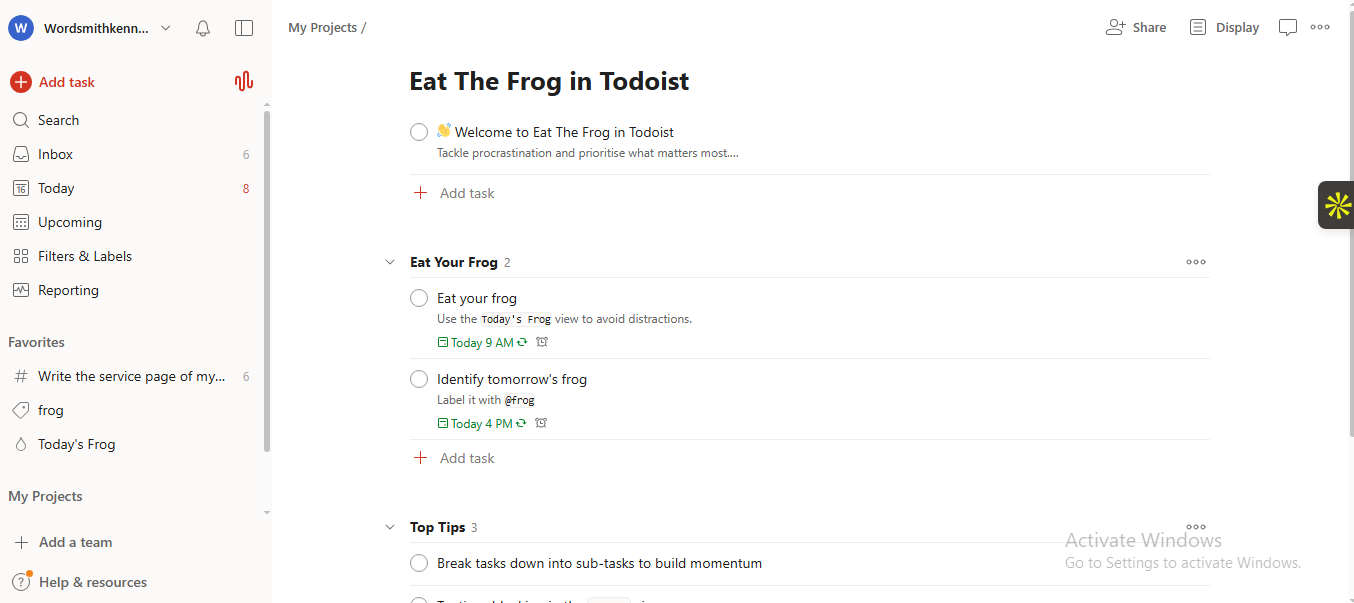
And if the task seems big and overwhelming, Todoist lets you break it down into a series of manageable subtasks. This makes starting easy, creating momentum that keeps you going.
I like eating my Frog during my peak productivity hours, which are usually in the late morning (10am to 12pm). Then, my energy, focus, and analytical thinking are at their highest.
How to get your To-do List Done
Writing a to-do list is quick and simple, like making tea. A pen and paper or a task management app—that’s all it takes. And in just a few minutes, you have one staring at you.
Now comes the hard part: completing the tasks. Yes, it can be demanding. And it even gets harder with distraction, fatigue, and a bloated list in the picture.
If you’ve been struggling to clear those tasks from your to-do list, here are some tips that will help:
1. Define smaller, actionable tasks.
Look…most of the time, you procrastinate not because you’re lazy. But because your tasks are too big or aren’t clear enough to take the first step.
Big tasks overwhelm the brain, triggering avoidance. Vague tasks? They increase cognitive load as your brain has to decide:
- Where to start
- How long will the task take?
- What to do first
That’s a lot of decisions for one task.
Defining tasks erases ambiguity, leaving little for the brain to mull over. This makes starting easy. For instance, instead of “Write an article,” you can break the task into clear and doable actions like:
- Choose an article title
- Draft outline
- Write introduction
- Write first H2
Completing each small step creates a sense of progress. This helps you build momentum. Want to make the process easier? Todoist lets you break tasks into smaller subtasks.
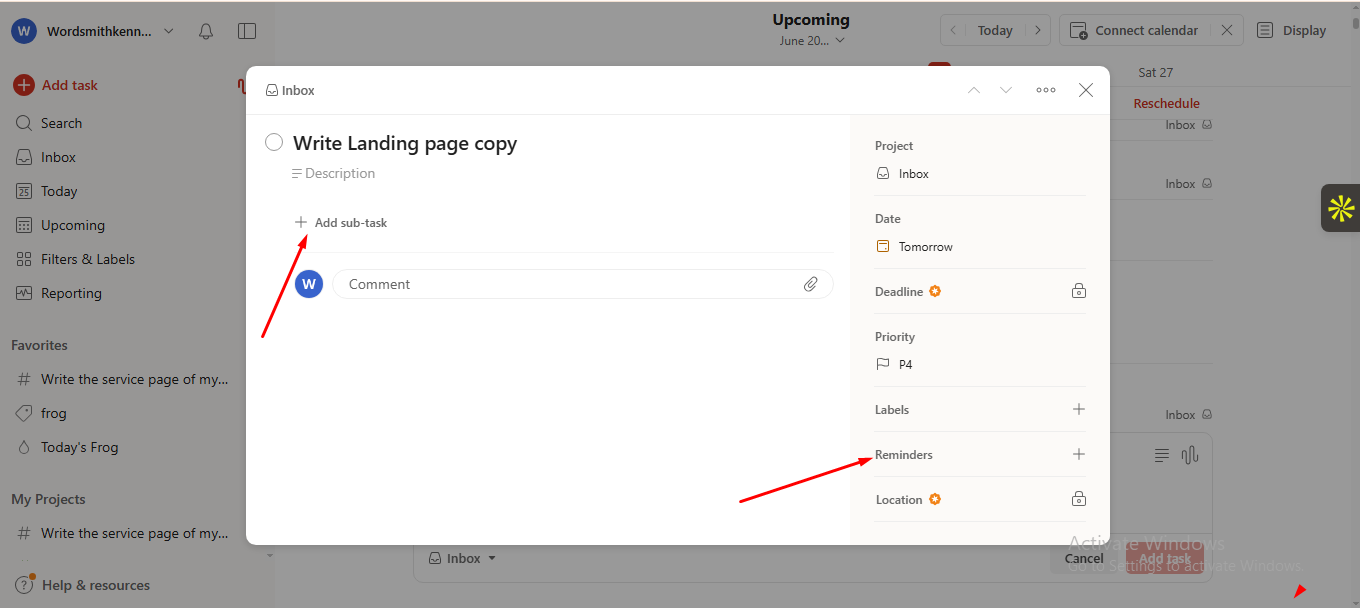
You can add descriptions, deadlines, attachments, and even reminders to ensure you follow through on each step.
2. Limit daily tasks (3–5 max)
We’ve all been there.
You add 10 tasks to your to-do list and convince yourself that you’d lock in and work hard like a machine—100% focus, unlimited energy, and zero distraction.
However, after 3 tasks in, your focus wanes, energy dips, and momentum dies. And there you are, overwhelmed and staring helplessly at your list, wondering why you decided to take on so much.
The truth is…
We usually underestimate how long it’ll take to complete a task, so we end up overcommitting. It’s called planning fallacy.
For example, back when I used to write my to-do list in a little notebook, I’d assign 6 tasks to each day. One time, I went as high as 10.
Of course, I didn’t complete up to 3 of the tasks on the list before I hit a wall. And because looking at the unfinished tasks filled me with guilt and productivity shame, I avoided the list entirely.
Things improved when I limited my daily tasks to 3-4 max. My to-do list appeared more realistic, and I was able to get it done with ease.
Here is what I recommend: Start with 3 tasks, then move to 4 or 5 when it feels comfortable. Pick tasks that truly matter and tackle the most difficult one first, especially during your peak energy hours. This helps build momentum and confidence, making the next task feel more doable.
3. Match tasks to energy levels
Have you ever tried tackling a complex task when drained? It’s like working with your brain at 20%. Simple steps become difficult. Your brain struggles to break down tasks. You overthink little choices. Mistakes pile up…and the list goes on.
Like tides, your energy levels rise and fall throughout the day. At 11am, you could be brimming with energy, ready to build a full-stack fintech software in a single stretch. Three hours later? You are there, drained and slumped on your chair as you fight the urge to take a nap or scroll through TikTok.
Research shows that most people experience a mid-afternoon energy dip (around 2-4 PM) due to the circadian rhythm. If this is you, scheduling creative and complex tasks during this period is a lost cause. No matter how you try, your brain will resist.
Do this instead: Match tasks to your energy levels.
Schedule simple tasks during low-energy periods, which are around 2-4 PM for the majority. Meanwhile, creative and complex tasks are best done when your energy is at its peak, which for most people, is usually around late mornings to early afternoons (9 AM to 1 PM).
As Tony Schwartz, renowned author, puts it: “Managing energy, not time, is the key to high performance and personal Renewal.” In other words, your productivity isn’t tied to how many hours you work. But how well you align your work with your energy levels.
4. Time-block your day
People cram their to-do lists, feel overwhelmed, and abandon them halfway.
Want to avoid overloading your list? Time-block your day! In other words, break your day into blocks of time and assign tasks to each.
Research shows that consistent time blockers experience a 41% reduction in feelings of overwhelm. They also completed 34% more planned tasks than those using only to-do lists.
What’s more, time blocking reduces context switching (the shifting of attention between tasks). This can waste up to 40% of productive cognitive capacity due to “attention residue” effects.
By time blocking your day, you:
- Boost deep focus,
- Create urgency (in a good way)
- Eliminate the “when should I start” conundrum.
- Become more intentional about which task to prioritize.
- And build momentum, increasing your chances of completing your tasks.
Todoist has a time duration feature that can be paired with calendar integrations to create time blocks. It supports two-way sync with calendar apps, so whatever changes you make in Todoist will automatically be reflected in your Calendar, and vice versa.
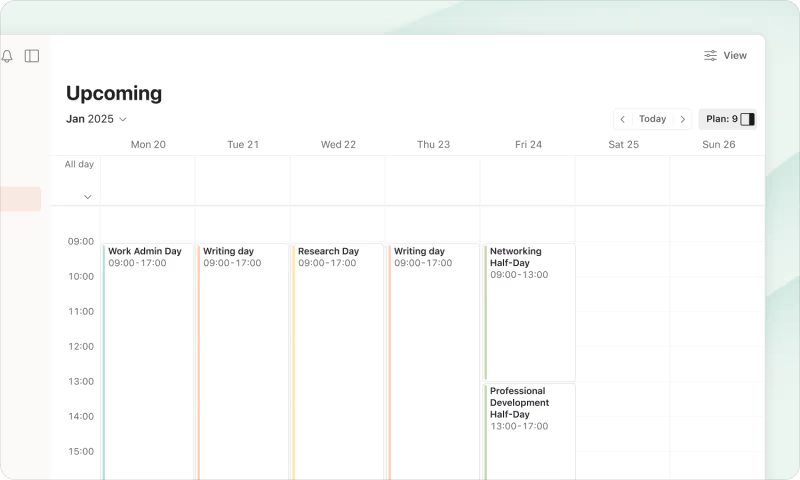
As a rule of thumb, when time blocking, don’t underestimate the duration of a task. Add buffers or extra time in case tasks take longer than you expected. You should also add breaks. According to studies, taking a 5-minute break every hour can increase productivity by 40%.
5. Prioritize ruthlessly
I get it.
Adding 9 tasks to your to-do list is the best way to end the day feeling like you did a lot. But the truth is, you can be busy—getting multiple tasks done—but not productive—working on tasks that don’t move you towards your goal.
Prioritizing your tasks is the best way to get the important stuff done while clearing your to-do list. A review of 107 studies found that prioritization, planning, and goal-setting are among the most effective productivity strategies.
To prioritize my tasks, I usually apply the Pareto principle. It states that 80% of results come from 20% of tasks.
So, I identify 20% of tasks that produce meaningful results. For example, if I wanted to study for an exam, I’d focus on the following 20%:
- Practicing past questions
- Active recall (test what I’ve learned)
- Focusing on what I’d most likely be tested on
Everything else is noise.
Next, I’d tackle the tasks ruthlessly. Since there aren’t many, completing my to-do list becomes easier. At the end of the day, I can toast to my productivity.
6. End-of-day reset system
How do you end your day?
Do you sit with your to-do list and conduct an end-of-the-day review? Or just call it a day? Most people end their day with half-done tasks stuck on their list, unplanned carryovers from previous days, and mental clutter that doesn’t go away.
And when they pick up their to-do list the following day, they’re overwhelmed with decision fatigue and a bloated list.
Sounds familiar? End-of-day reset fixes this!
It involves reviewing your day, deciding what matters, and intentionally reassessing your task list for the next day. This gives your day a structured ending and offers clarity for the following day.
Meaning, when you wake, you wouldn’t be trying to:
- Re-decide priorities
- Rethink what to do
- Mull over where to start
This saps your energy even before real work begins.
Conducting an end-of-the-day review also allows you to intentionally reschedule unfinished tasks, preventing task pileup. While it’s normal to want to push these tasks to the next day, doing so creates an unrealistic, overwhelming plan that hinders your focus.
Do this instead: Ask yourself, “Does this matter tomorrow?” If yes, move it—if no, discard it. This ensures that you focus on tasks that move the needle.
With Todoist, you can easily reschedule tasks by dragging and dropping them to the next day (tomorrow) or editing the due date.
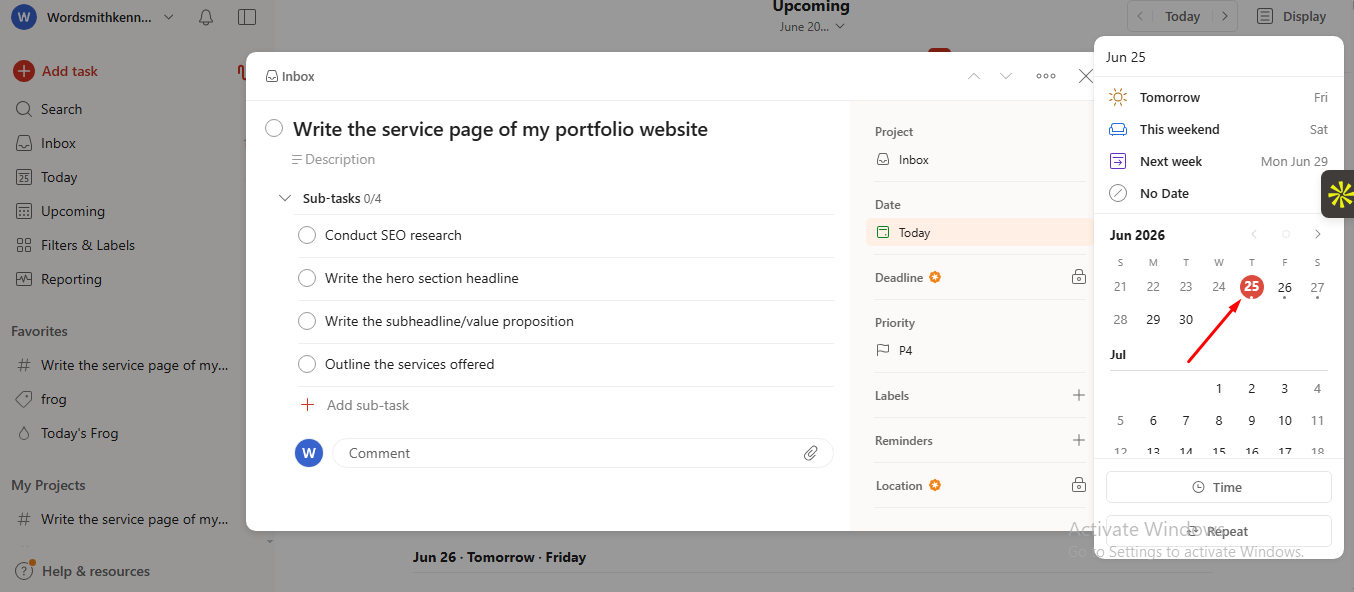
This feature is liked by users.
In fact, one G2 reviewer said this when asked what they liked best about Todoist:
“The ability to reschedule extremely quickly and keep tasks organized. The interface is very easy to use and allows me to navigate between multiple tasks very quickly.”
Just so you know, there’s no shame in rescheduling a task for the next day. Life happens, and plans change. However, if you keep rescheduling a task, it’s probably a sign that it needs to be discarded.
How to finally get things done
It’s hard to be productive when you always struggle to finish your to-do list. Most of the time, it’s not completely your fault. Neither is it a motivation problem. Not finishing your list is usually the result of unrealistic planning, distractions, having too many tasks, and vague priorities.
By setting 3-5 priority tasks per day, matching tasks (especially complex ones) to peak energy periods, eating your frog (tackling your most difficult task first), and eliminating distractions, you increase your chances of crushing your to-do list and having a productive day.
Remember, productivity isn’t about executing 8 low-impact tasks that make you appear busy. It’s about tackling those 3 high-leverage tasks that make a real difference.