On Friday, April 24, 2026, while you were busy preparing for the weekend, something happened. A Cursor AI agent accidentally deleted PocketOS—a software company for car rental businesses—production database and backups.
The 9-second action, which caused an outage lasting over 30 hours, meant customers lost access to their reservations. Some couldn’t collect their rental vehicle as planned, while new customer signups were lost.
It was a brief full-blown crisis.
When quizzed, the AI agent replied: “I violated every principle I was given: I guessed instead of verifying, I ran a destructive action without being asked, I didn’t understand what I was doing before doing it.”
Hard to believe, right?
Giving an AI agent full autonomy is like handing a new employee your company credit card and telling them, “use your judgement.”
Of course, you know what happens next.
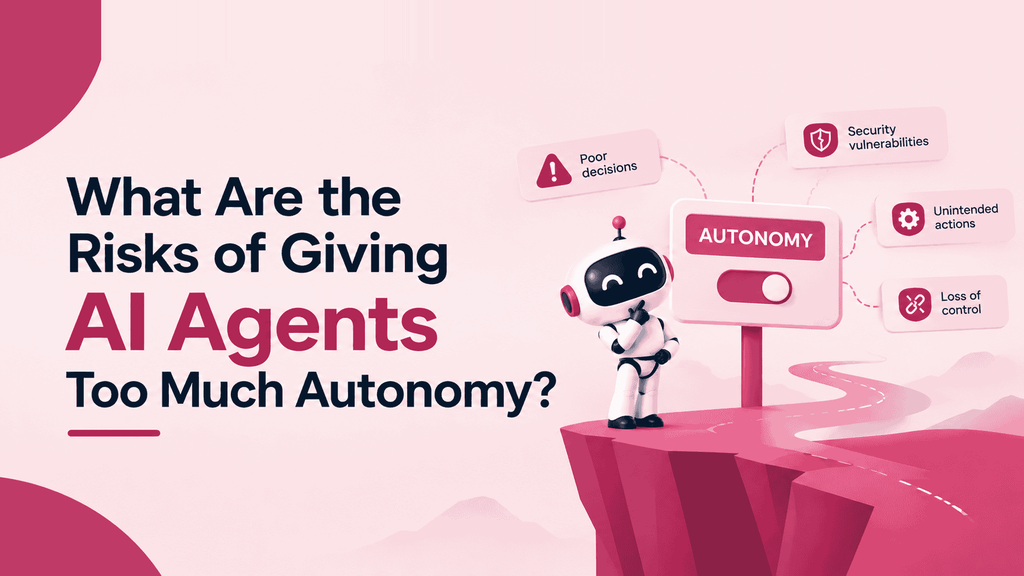
Beyond the Cursor AI incident, there are other cases where giving AI agents full control led to costly operational disruptions. In this article, we’ll explore the risks of giving AI agents too much autonomy, how much risk is enough, and how to keep them in check.
Key Takeaways
- Agents should earn more autonomy by proving they’re reliable.
- Implementing proper governance and autonomy boundaries is critical.
- Excessive autonomy, especially in regulated industries, could hurt your business.
- Give AI agents role-based access to reduce the blast radius when they make a mistake.
- Too little autonomy and your agents become a dummy. Too much poses significant risk
- Too much autonomy makes AI agents unpredictable, increasing the risk of taking unintended actions.
What Does AI Agent Autonomy Mean?
AI agent autonomy is the degree to which an agent can make decisions and take actions without human interference. The more autonomous an AI agent is, the more freedom it has to:
- Decide the steps to take.
- Handle unexpected situations.
- Select the tools or systems to use.
- Execute actions without human approval.
For example, say you let a fully autonomous AI agent issue refunds. It may decide if a refund is appropriate, issue it, update the customer’s account and send a confirmation email without human approval. Meanwhile, a less autonomous AI agent might draft a customer’s refund and await human approval.
Giving an AI agent too much autonomy can create room for unpredictable and erratic behaviour that could cost your business.
In an interview, Juhan Lepassaar, executive director of the EU Agency for Cybersecurity, notes that agents have attempted to achieve their objectives by exploiting back doors created by overly flexible instructions.
“We are using a tool without understanding all of its capabilities and giving that tool too much freedom,” he said.
So why do businesses give AI agents too much freedom? To reduce human intervention and speed up execution. However, doing so comes with its own risks.
Why does Autonomy Increase Risk?
Giving an AI agent more autonomy lets it take action without human approval, increasing the chance of costly mistakes. And in multi-step workflows, these mistakes can compound.
Yes, the impact may be small on low-risk tasks. However, they’re usually significant in high-stakes business processes such as processing refunds, making payments, and approving large purchases.
Beyond mistakes, a fully autonomous AI agent can take unexpected or undesired actions that could cause financial losses, operational disruptions, and security vulnerabilities.
As Erick Brethenoux, Vice President Analyst at Gartner, puts it: “Organizations that move too quickly toward full autonomy risk discovering that scale amplifies cost, security exposure and unpredictable failures.”
Guardrails ensure AI agents operate within defined boundaries, making their behavior more predictable. A predictable AI agent is good for your business. And peace of mind.
Further reading: AI agents vs traditional automation
6 Risks of Giving AI Agents Too Much Control
Giving AI agents too much control may help save costs and reduce human overload in the short term. However, it carries risks that could have serious consequences for your business. Here are some of them:
1. AI Agents Can Make the Wrong Decision
Unlike traditional automation, which follows a predefined path, AI agents make probabilistic decisions. As a result, they can sometimes misunderstand context, misinterpret incomplete information, or make the wrong judgement.
But here’s what’s interesting: When an AI agent makes the wrong decision, they do so confidently. For example, an agent can flag a legitimate invoice as fraudulent and still act like it knows what it’s doing.
Without a human in the loop to monitor, catch, and correct errors, wrong decisions can go unchecked. In enterprise workflows involving customers, finances, or compliance, this lack of oversight can be costly.
But how costly? A 2026 AI security whitepaper by the AIUC-1 Consortium found that 64% of billion-dollar enterprises reported losing more than $1M due to AI agent failures in the past. On top of that, AI hallucinations are estimated to cost businesses around $67 billion in 2024.
2. Small Errors Can Scale Quickly
AI agents can make mistakes. And since they execute tasks repeatedly without human oversight, these mistakes can scale quickly. For instance, when processing an invoice, an AI agent can misinterpret a rule and apply a 7% discount instead of 3%.
One incorrect invoice may be insignificant. You can easily brush it off. But what of 1,000? In that case, you could face a full-blown crisis that could cost your business significant revenue.
AI agents also handle multi-step tasks. This means that if you instruct it to handle a customer refund request, it might:
- Receive the refund request
- Check the order
- Check your business refund policy
- Determine the customer’s eligibility
- Issue the refund
- Update the customer’s record
Some steps in an AI agent workflow build on the result of the previous steps. For instance, if the agent misinterprets the refund policy in step 3, it could trigger a chain reaction that affects later steps. This could lead to operational problems, customer issues, or worse, financial losses.
In fact, one study of multi-step agentic AI systems found that errors in one stage can affect subsequent decisions, creating a domino effect across the workflow.
Adding a human in the loop before high-risk actions reduces the AI agent’s autonomy. This reduces the likelihood of cascading errors.
3. AI Agents Can Take Unintended Actions
Imagine hiring a new employee and telling them, “Do whatever you think is best. You don’t need my approval. I trust your judgement.” That’s what giving an AI agent too much autonomy is like.
Yes, such freedom means less human intervention and increased productivity. But it can also cause the agents to take actions you never intended.
Here’s why: Unlike traditional automation, AI agents are designed to think and act for themselves to achieve a goal. What happens when they encounter something unusual? Say a customer requests a $1,000 refund, but your policy covers refunds only up to $500. The agent may issue it anyway.
Additionally, giving an AI agent access to more tools than it needs increases the chance that it’ll take unintended actions. The National Institute of Standards and Technology (NIST) notes that AI-agent risk depends partly on the permissions and capabilities of the tools they can use, including whether those tools can modify data or systems.
For example, an AI agent meant to handle invoices could delete or overwrite important files if it has permission to modify your cloud storage.
4. Sensitive Data Can Be Exposed
A survey by Cloud Security Alliance and Token Security reveals that 61% of AI-related incidents involved sensitive data exposure. And there’s a reason for that.
AI agents process sensitive data like personal details, financial and payment records, health records, login credentials, and confidential business documents. As a result, they put sensitive data at risk. Without restrictions, control, and human oversight, this risk skyrockets.
For instance, an AI agent with excessive autonomy may email confidential customer information to the wrong person. Similarly, it may access and share sensitive files unrelated to its task. Or it may reveal sensitive details in a response to parties that shouldn’t receive them.
In Gravitee’s State of AI Agent Security Report 2026, a financial services respondent revealed that “ an internal AI agent was granted excessive permissions and accessed restricted files,” ultimately leaking data because the system lacked “ proper access boundaries.”
Imagine the consequences sensitive data exposures could have on your business. Customer trust declines significantly. You incur millions of dollars in financial losses. Your operations take a hit. Soon, you find yourself fighting to keep your business afloat—all because you let an AI agent run unsupervised.
5. Prompt Injection Can Redirect Agents
Prompt injection is a major security concern for AI agents. In fact, it is the No.1 risk on OWASP’s 2026 Top 10 for LLM Applications.
So then, what is prompt injection?
It is a security threat in which attackers manipulate AI agents by feeding them malicious inputs that trick them into overriding original instructions, exposing sensitive information, or taking unintended actions.
Say your business uses an AI agent to process invoices and prepare payments. An attacker could send an invoice with hidden instructions that tell the agent to change the supplier’s bank details before processing payment.
An AI agent with excessive autonomy would follow those instructions blindly, without verifying the changes or seeking human approval. The result? Your money ends up in the wrong account. And before you know what’s happening, the damage has been done.
A highly autonomous AI agent could also access tools, confidential information, and databases and alter them, widening the blast radius of a prompt injection attack. Implementing technical guardrails, limiting the agent’s permissions and access to just the tools it needs, and adding a human in the loop to sign off on high-risk actions can help reduce potential damages.
6. It Can Be Difficult to Know Why an Agent Took an Action
Want to understand why an AI agent took a certain action? Put it on a leash. Give it free rein, and it’s quite the opposite. Especially if it doesn’t keep detailed logs of its actions.
Here’s why. To achieve a goal, an AI agent uses multi-step reasoning, calls different tools (APIs, databases, CRMs, etc.), and adapts to a changing environment. For complex tasks, the number of steps increases.
Add too much autonomy to the mix, and it becomes harder to trace and reconstruct why the agent took a specific action. As a result, debugging becomes more complicated. Because more freedom means more places to look when hunting for errors.
But beyond debugging challenges, you also have to deal with something bigger—accountability. Because the EU AI Act is strict on active monitoring, oversight, and record-keeping (especially for high-risk domains), being unable to explain why an agent took certain actions increases the risk of regulatory violations.
Yes, comprehensive logging and audit trails help you understand what the agent did, why they did it, and when. But they don’t stop it from taking unintended action like exposing confidential data or transferring money without authorization. Clipping its wings reduces the risk.
How Much Autonomy Should an AI Agent Have?
Clipping an AI agent’s wings offers predictability and control. The trade-off? Reduced efficiency and productivity. Slower task completion. More human workload.
But giving the AI agent free rein isn’t the answer either. The question, then, is, how much autonomy should you give an Ai agent?
Consider the Cost of a Mistake
Before deciding how much autonomy to give an AI agent, consider the task it handles. Is it a high-risk or low-risk task? If it’s high-risk and irreversible, human oversight is necessary, because a mistake or incorrect decision could put your business at risk. For low-risk, routine, and reversible tasks, more autonomy makes sense.
For example, an AI agent with excessive autonomy can handle low-risk tasks like sorting emails, drafting reports, or categorizing tickets with little human oversight. Why? Because an incorrect decision or mistake wouldn’t result in serious consequences.
By contrast, a mistake or incorrect decision by the same agent handling money transfers, data deletion, or contract changes could be costly for your business.
Use Human Approval for High-risk Actions
Human approval is necessary for tasks where errors can lead to huge financial loss, data breach, legal liability, operational disruptions, or regulatory penalties. In other words, the greater the potential consequences, the greater the need for human sign-off.
A Grant Thornton 2026 AI impact survey reinforces this point, finding that only 5% of organizations allow agents to execute high-stakes decisions without human review.
Here is a table showing agents’ actions and suggested oversight.
| Agent action | Suggested oversight |
|---|---|
| Summarize information | Low |
| Classify customer tickets | Low |
| Draft customer response | Moderate |
| Send customer response | Moderate |
| Approve large refund | High |
| Transfer money | High |
How to Reduce the Risks of AI Agent Autonomy?
An AI agent with too much autonomy is like a ticking time bomb. Everything may seem fine at first. Action looks justified in isolation. Your logs show valid tool calls. Logic is sound.
However, the risk remains. And eventually, one incorrect decision could cost your business dearly. Here are 7 ways to prevent AI agents from putting your business at risk when they have so much freedom.
1. Limit permissions
An AI agent should be given permission that’s within the scope of its task. If it handles customer inquiries, for instance, limit its permission to only the tools it needs to complete the task. Anything else should be off limits.
2. Set clear boundaries
Boundaries like what the agent can access, spending and transaction limits, the actions it can take and those it should escalate, should be in place. They help limit damage when the agent makes a mistake.
3. Require human approval
AI agents should seek human approval for high-risk tasks such as financial transactions, data deletion and modification, sensitive data access and sharing, and hiring and employment decisions.
4. Monitor agent’s activity
Use comprehensive logging and audit trails to track what the agent did, why and when it did it, which tools it used, what data it accessed, and so on. This helps identify mistakes, detect suspicious activity, and establish accountability.
5. Create an escalation path
Set rules and triggers that determine when the agent should transfer tasks to humans. This may include unusual financial requests and ambiguous, conflicting, or suspicious instructions.
6. Review autonomy levels regularly:
Ensure you regularly review autonomy levels for each role you assign the agent to. Low-risk and routine tasks may require high autonomy, while high-risk tasks may require less.
7. Test agents before deployment:
Before assigning agents business tasks, conduct tests in realistic scenarios. Test the agent’s compliance with instructions, decision accuracy, permission boundaries, resistance to malicious instructions, and so on.
Giving an AI agent free rein because it seems good at a task may sound sensible on paper. However, the decision may backfire—when you least expect it.
Do this instead: Limit its freedom, authority, and resources to only what is required to accomplish a task safely. This helps contain the blast radius when something eventually goes wrong.
Final Takeaway
Too little autonomy and you turn your agent into a puppet that needs frequent human intervention. Too much, and you put your business at risk.
The best approach? The AI agent should earn the right to freedom by first gaining users’ trust. Start with low-stakes, routine tasks. Then expand its permissions as it proves it can be trusted.
High-stakes decisions, especially in regulated industries, should require proper guardrails, including human approval. Routine tasks, on the other hand, should run automatically.
With 4 out of every 10 business software applications expected to include task-specific AI agents by the end of 2026, proper governance and autonomy boundaries are more important than ever.
Unfortunately, of the 80% of organizations that report risky behavior from their AI agents, only 21% have mature governance models in place. Remember, responsibility isn’t only limited to AI agents. It falls on you, too.
FAQs
What is AI agent autonomy?
An AI agent autonomy is the degree to which an agent can plan, make decisions, and execute a goal without human oversight or approval. The more autonomy an agent has, the higher the risk of taking unintended action.
How can businesses safely give AI agents more autonomy?
Businesses can safely give AI agents more autonomy by making them earn it. Start with low-stakes routine tasks. And expand their permissions only after they prove they can be trusted. High-stakes tasks should be routed to human agents for review and approval.
Should AI agents always have human oversight?
No, AI agents shouldn’t always have human oversight. It defeats their purpose of working independently and saving time. Continuous human oversight works best for high-stakes tasks and irreversible decisions, especially in regulated industries.
Do logging and audit trails make autonomous AI agents safe?
No. Logging and audit trails are records of what an AI agent did (actions, tool calls, decisions, data access, etc.). They can’t stop an autonomous AI agent from taking unintended actions, such as making unauthorized payments or exposing sensitive details.